Drawing: what it costs and who it fits
A pencil and paper habit that visibly improves within a few weeks.
Prices checked August 6, 2026 / 2 sources linked / Oded Rochman
What it costs
| Item | Figure | What it covers |
|---|---|---|
| Starter gear | $15–$60 | One-off, everything you need for a first real attempt. |
| Running cost | $0–$15 a month | Materials and consumables at a steady weekly habit. |
| Time per session | 15 min–1.5 hr | The normal working block, not the maximum. |
| Time to first win | One session | Until you make something you would show someone. |
Every figure here is dated and linked to a live listing under Sources. The same costs across every hobby we track are compared in what hobbies actually cost.
Drawing is the cheapest serious skill available to an adult with an hour a week, and the only equipment decision that matters costs under fifteen dollars. It suits people who want a hobby with no setup, no teardown, and no minimum session length. The honest catch is that the gap between what you see and what your hand puts down stays wide for months, and most beginners quit inside that gap rather than working through it.
What it actually costs
The cheap entry path is real, not a marketing number. A 9 x 12 inch Strathmore 400 Series sketch pad sells for $6.24 at Blick, and a set of six Staedtler Mars Lumograph pencils is $8.99. That is a complete, sufficient kit for about $15, and nothing about it is a compromise. Professional illustrators use the same paper and the same pencils.
The mid-path adds range rather than quality. The twelve-pencil Lumograph set is $15.52 and gives you softer grades for deep shadow. Larger pads in the same 400 Series line run up to $29.47. Together that is a $45 setup, and it is the ceiling for a first year. There is no expensive tier in drawing worth reaching for as a beginner, which is unusual among creative hobbies.
Ongoing cost is paper alone. Someone drawing most days works through one pad every few months, so the running cost sits at a few dollars a month rather than the fifteen-dollar upper bound in the cost table. Digital drawing on a tablet moves the number by hundreds of dollars and does not make you better faster, so leave it until you know you are staying.
What to buy first
The sketch pad at $6.24 and the six-pencil Lumograph set at $8.99. That is $15.23 and it is not a stripped-back version of the hobby, it is the hobby. Six grades cover the full range from light construction lines to dark accents, which is enough to learn value, and value is the whole beginner curriculum.
The twelve-pencil set at $15.52 has the narrowest trigger on this page: buy it when the six-pencil set runs short, meaning you have worn down specific grades through use. That is a real signal about what you draw. Buying twelve at the start gives you six pencils you will not touch and a choice to make every time you pick one up, which is friction at exactly the wrong moment.
Paper is where any extra money should go, not pencils. The 400 Series is heavyweight enough not to buckle under graphite, and thin paper is the material failure most likely to make competent drawing look bad. If you upgrade one thing in your first year, upgrade the surface.
Time to your first win
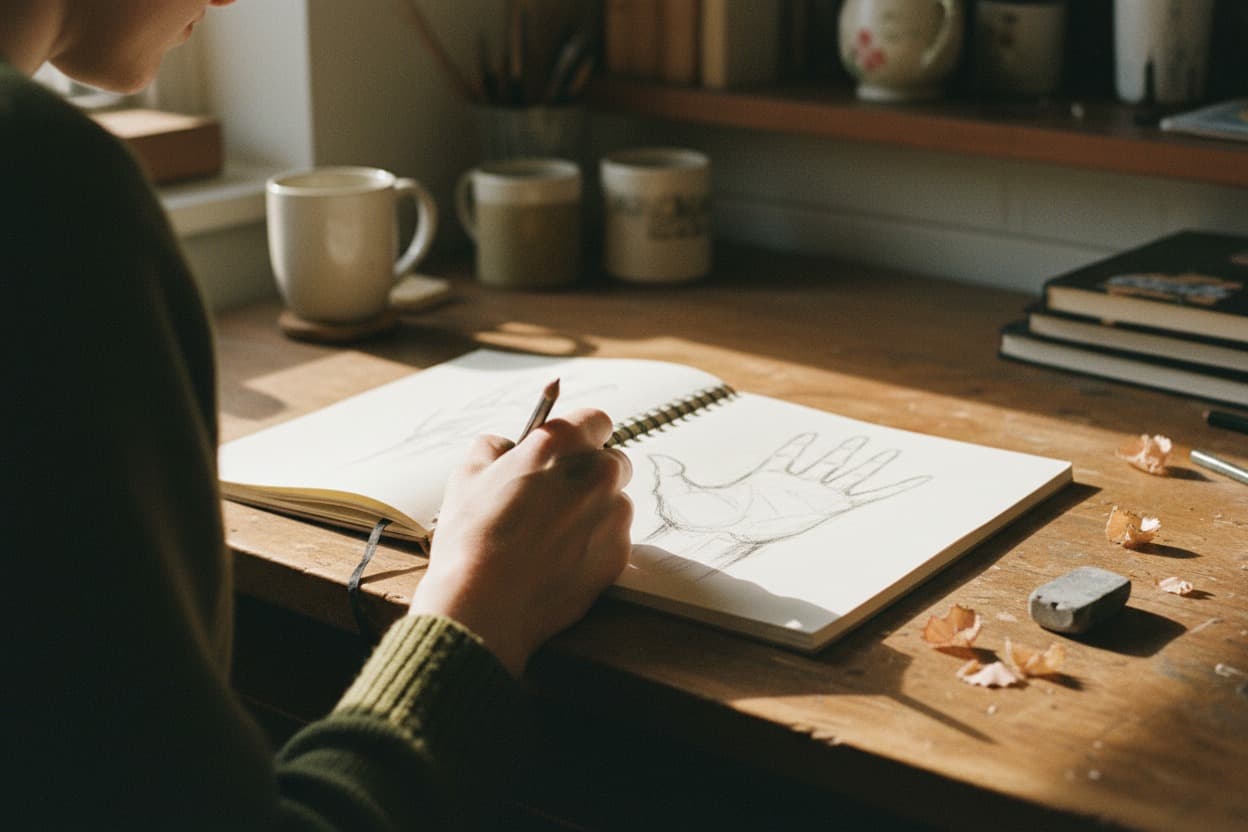
Day one produces something recognizable. Draw a coffee cup, a hand, a shoe, and you will get a shape that reads as the thing. That is genuinely a win and it is why drawing has one of the shortest paths to a first result of any creative hobby.
The satisfying win, a drawing you would leave on the table for someone else to see, usually lands around week six of drawing most days for fifteen to twenty minutes. What changes in that window is not manual dexterity, which barely improves. What changes is that you stop drawing what you know an object looks like and start drawing what is actually in front of you. That switch is the whole beginner curve.
Expect a visible plateau in month three. It is normal and it breaks if you change subject matter rather than trying harder at the same subject.
You'll enjoy this if
- Your free time arrives in ragged fifteen-minute pieces rather than clear evenings.
- You want a hobby you can do on a couch, a train, or in a waiting room with no preparation.
- You are willing to make a large volume of mediocre work before making a small amount of good work.
- You like noticing things. Most of the skill is looking carefully, not moving your hand well.
- You want a screen-free activity that leaves a physical record of whether you actually showed up.
Skip it if
- You need a finished, giftable object quickly. Try watercolor painting for faster visual payoff, or a making hobby with a hard output.
- Comparison online will wreck you. Drawing has the most crowded and most intimidating public feed of any beginner hobby.
- You want measurable progress. There is no score, no belt, and no clear level system.
- You are hoping the right pencils will fix the problem. They will not, and the search for them is the most common way beginners stall.
Your first month
- Buy the $6.24 pad and the $8.99 pencil set. Buy nothing else for thirty days, including erasers you think you need.
- Draw for fifteen minutes a day, five days a week. Set a timer and stop when it goes, including mid-line.
- Spend the first two weeks on single objects on a table in front of you. No photos, no imagination, no faces.
- In week three, start drawing the same object three times in a row. The third attempt teaches more than the first ten different objects did.
- Date every page and never tear one out. The pad is the evidence, and comparing week one to week four is the main thing that keeps people going.
If you are still deciding between this and something with a more social shape, the guide to finding a hobby as an adult works through the trade-offs, and the cheap hobbies list covers the other sub-$50 starts worth considering.
Starter gear worth buying
Strathmore 400 Series Sketch Pad, 9 x 12 in
$6.24
Heavyweight sketch paper that takes graphite without buckling
Staedtler Mars Lumograph pencils, set of 6
$8.99
Enough hardness range to learn value without paralyzing choice
Staedtler Mars Lumograph pencils, set of 12
$15.52
Buy this only after the six-pencil set runs short
Try it with a class
Drawing for Beginners Level -1
Domestika. Cheaper than a starter kit, and you find out in a weekend whether the craft suits you.
Gear and class links may earn us a commission. It never changes the price, or which gear we recommend.
Common questions
- Is drawing expensive to start?
- No. A 9 x 12 inch Strathmore 400 Series sketch pad is $6.24 at Blick and a set of six Staedtler Mars Lumograph pencils is $8.99, so a complete start is about $15. Ongoing cost is paper only. A daily fifteen-minute habit burns through roughly one pad a season, which keeps the running cost near a few dollars a month.
- Is drawing a good hobby for adults?
- It fits adults better than most creative hobbies because it has no setup and no teardown. You can work in fifteen-minute pieces, stop mid-drawing, and carry the whole kit in a bag. The trade is that improvement is visible but slow, and the first two months look worse than you expect them to.
- How long does drawing take to learn?
- You will produce something recognizable on day one. Drawings you would show another person usually arrive around week six of near-daily practice. Accurate proportion and confident line work take one to two years. The people who get there draw small and often rather than occasionally and ambitiously.
- Can I draw in a small apartment?
- Yes, and it is one of the few creative hobbies with no space penalty at all. Drawing needs a lap or a table corner, makes no noise, produces no fumes, and leaves nothing to store beyond finished pads. There is nothing to set up before a session and nothing to clean after one.
- Do I need talent to draw?
- Beginners overweight talent and underweight mileage. Drawing is mostly trained observation, and observation responds to repetition. The reliable predictor of progress is how many days a week you draw at all, rather than how good your first attempts looked. Anyone who can write legibly already has enough manual control to draw well.