Watercolor Painting: what it costs and who it fits
Loose, forgiving color work you can finish in a single sitting.
Prices checked August 6, 2026 / 3 sources linked / Oded Rochman
What it costs
| Item | Figure | What it covers |
|---|---|---|
| Starter gear | $30–$120 | One-off, everything you need for a first real attempt. |
| Running cost | $10–$30 a month | Materials and consumables at a steady weekly habit. |
| Time per session | 30 min–1.5 hr | The normal working block, not the maximum. |
| Time to first win | 2 days | Until you make something you would show someone. |
Every figure here is dated and linked to a live listing under Sources. The same costs across every hobby we track are compared in what hobbies actually cost.
Watercolor fits people who want to finish something in one sitting and who own a corner where a small setup can live. Thirty to ninety minutes is a complete painting. The catch is control: watercolor is the least correctable painting medium there is, and the property that makes it beautiful, pigment moving in water, is exactly the property that makes it unpredictable.
What it actually costs
The cost table on this page shows $30 to $120 to start, and the low end is a complete, honest kit rather than a stripped-down one.
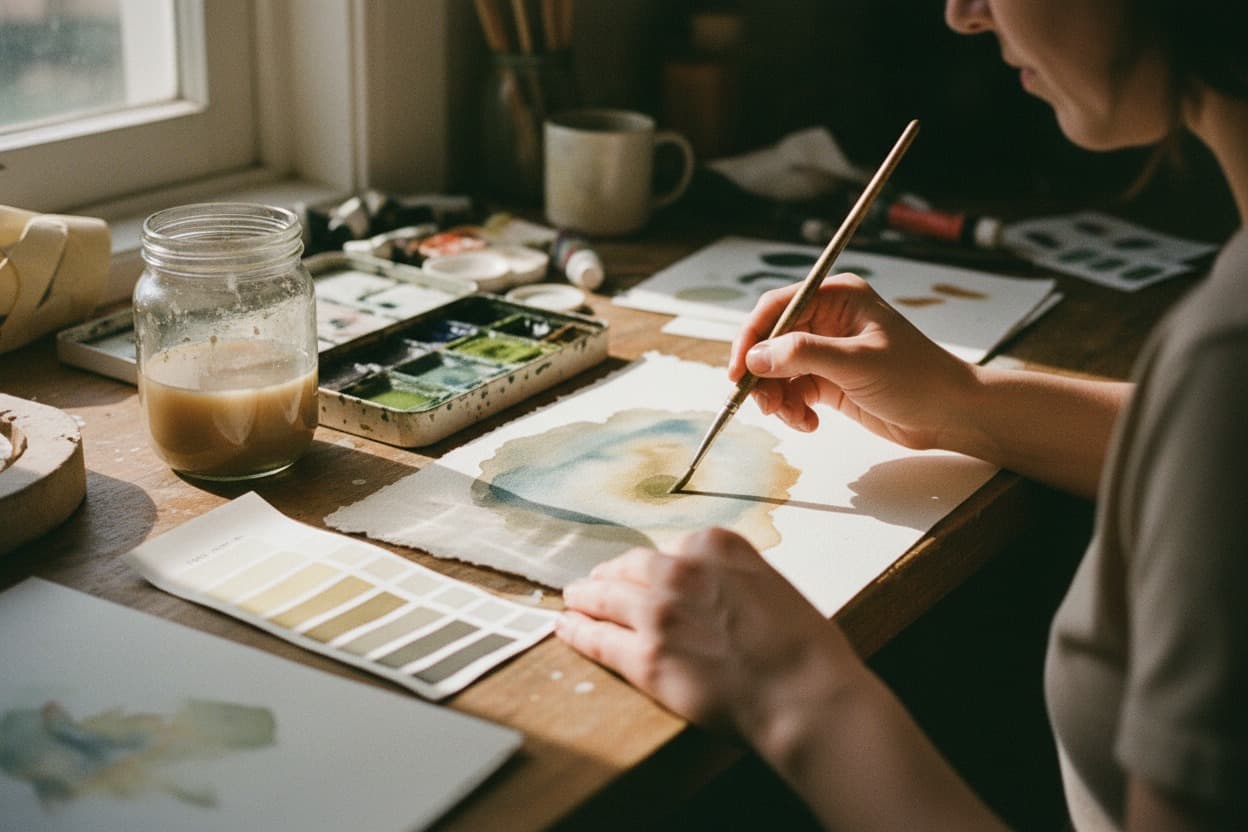
The cheap entry path is three items. A Winsor & Newton Cotman Sketcher's Pocket Set of 12 half pans is $21.51 at Blick, down from a $38.49 list. Cotman is student grade, which here means the pigments are less concentrated, not that they misbehave. A Canson XL watercolor pad, 9x12, 140 lb cold press, 30 sheets, is $7.70. One Princeton Select Series 3750 round brush runs $3.54 to $10.60 depending on size. That is about $35 for everything, plus a jar of water and a rag.
Spend the money on paper before paint. Cheap thin paper buckles and refuses to let pigment move, and beginners consistently blame their own skill for what the paper is doing. A 140 lb cold press sheet is the floor for the medium behaving as intended.
The mid-path is artist-grade paint and cotton paper, and it is a real difference rather than snobbery. It is also a month-six decision. The $10 to $30 monthly range in the table is almost entirely paper: a 30-sheet pad at $7.70 lasts a few weeks once you start painting regularly, because you will paint a lot of sheets you throw away.
What to buy first
The Cotman pocket set at $21.51, a Canson XL pad at $7.70 and one round brush at $10.60. Under $40 for a complete kit, and complete is the accurate word: student-grade Cotman behaves properly rather than being a compromise, and twelve half pans mix far more colours than a beginner can use.
Paper is where watercolour beginners actually fail, and it is the cheap item. The Canson XL at 140 lb is heavy enough not to buckle when wet, which is the difference between a wash that settles and a cockled sheet that pools. Thin paper makes competent painting look bad, and people conclude they cannot paint.
The small round at $3.54 is a real second brush with a real trigger: one round has stopped being enough for the detail you are attempting. That is a specific frustration, not a date. One good round does about 90 percent of beginner work, which is why brush sets are the classic waste here.
Cheap paper is the thing to buy generously. Being willing to waste a sheet is most of learning this.
Time to your first win
Two days. A loose wash of a sky, a simple landscape band or a single leaf comes out looking intentional early, because watercolor is forgiving of vagueness in a way that drawing is not.
The honest part comes immediately after. Controlling water is the entire skill and it takes three to six months. Too much water and the paint blooms into places you did not want. Too little and it dries streaky and flat. You cannot lift a mistake back off the way you can with acrylic or oil, so the medium demands that you decide before the brush touches the paper.
This makes watercolor unusually front-loaded with frustration. People who quit almost always quit in month two, having produced ten muddy paintings in a row. Muddiness is nearly always the same two errors: too many layers, and touching a wash while it is still drying. Both are fixable by waiting, which is a discipline rather than a technique.
You'll enjoy this if
- You want a finished piece from a single sitting rather than a project that spans weeks.
- You like results that look loose and atmospheric more than tightly rendered.
- You have a corner where paper, water and a pan set can stay set up.
- You want a hobby that packs into a bag and works outdoors on a bench.
- You can accept that some paintings are simply lost and start again on a fresh sheet.
Skip it if
- You need control and correctability. This is the wrong medium and gouache or acrylic is the right one.
- Being unable to undo a mistake genuinely upsets you.
- You have nowhere you can leave something wet for an hour.
- You want to draw accurately first. Learn drawing first and come back to watercolor with it.
- You need visible weekly improvement. Progress in watercolor arrives in sudden steps after long plateaus.
Your first month
- Buy the $21.51 pan set, the $7.70 paper pad and one round brush. Do not buy tube paints, a palette or a dozen brushes yet.
- Spend the first two sessions on washes only, no subject. Flat wash, graded wash, wet-on-wet. This is the whole medium in miniature.
- Paint the same simple subject five times rather than five different subjects once. Repetition is what teaches water control.
- Let every layer dry completely before adding another. Most beginner mud comes from impatience, not from bad paint.
- Keep every painting for a month, including the bad ones. The progress in watercolor is invisible day to day and obvious across thirty sheets.
If you want more control over the result, drawing teaches the accuracy watercolor assumes you already have. For handwork with a decorative result at a similar price, embroidery starts even cheaper. Watercolor is one of the better-value entries on our cheap hobbies list.
Starter gear worth buying
Winsor & Newton Cotman Sketcher's Pocket Set, 12 half pans
$21.51
Student grade that behaves properly; travels in a pocket
Canson XL Watercolor Pad, 9x12, 140 lb, 30 sheets
$7.70
Cheap enough to waste, heavy enough not to buckle
Princeton Select Series 3750 round brush
$10.60
One good round does 90 percent of beginner work
Princeton Select Series 3750 small round
$3.54
Second brush for detail once one round stops being enough
Try it with a class
Creative Watercolor Sketching for Beginners
Domestika. Cheaper than a starter kit, and you find out in a weekend whether the craft suits you.
Gear and class links may earn us a commission. It never changes the price, or which gear we recommend.
Common questions
- Is watercolor painting expensive to start?
- No. A Winsor & Newton Cotman Sketcher's Pocket Set of 12 half pans is $21.51 at Blick, and a Canson XL 140 lb cold press pad of 30 sheets is $7.70. Add one round brush at $3.54 to $10.60 and a complete kit is around $35. Paper, not paint, is the ongoing cost.
- Is watercolor painting a good hobby?
- It fits people who want to finish something in a single sitting and who have somewhere to leave a small setup out. Sessions run 30 to 90 minutes and a painting is usually done in one. It is a poor fit if you need control, because the medium is deliberately hard to correct.
- How long does watercolor painting take to learn?
- You will finish a painting you do not hate within two days of starting. Controlling water, which is the entire skill, takes three to six months. Watercolor is unusually front-loaded with frustration: the technique that makes it beautiful, letting pigment move in water, is also what makes it unpredictable.
- Why does everyone say to buy good paper?
- Because cheap paper buckles, pills and refuses to let pigment spread, and beginners blame themselves for what the paper is doing. A 140 lb cold press sheet is the minimum that behaves properly. Spending $7.70 on a proper Canson XL pad fixes more beginner problems than upgrading from a $21.51 pan set to artist-grade tubes.
- Can I paint in watercolor in a small apartment?
- Yes. The whole kit is a pan set, a pad, two brushes and a water jar, and it packs away into a drawer. There is no noise and no fumes. The one real requirement is a surface you can leave slightly wet and stained, or a board you can lift and move.